
Why This Paper Exists
Stress is everywhere.
Understanding it is not.
Over the last decade, stress has been framed in familiar ways:
-
as an emotional problem
-
as a mental health issue
-
as a productivity failure
-
as a lifestyle imbalance
Each framing offers tools.
None offers a map.
The result is predictable.
People try meditation, supplements, therapy, motivation, resilience training, productivity systems, often all at once, without ever understanding what stress is actually doing inside the body.
Most interventions arrive late.
By the time stress feels obvious, the system has already adapted around it.
This white paper exists to address that gap.
It begins from a simple premise:
Stress is not an emotion.
Stress is a multi-layered biological negotiation.
The Problem Is Not Ignorance. It Is Misreading.
Most people do not ignore stress.
They misread it.
Early stress signals rarely look alarming.
They look ordinary.
-
thinking becomes noisier
-
rest stops restoring fully
-
tolerance shrinks slightly
-
effort increases without collapse
Because these changes do not feel dramatic, they are normalised.
By the time stress is named, the body has already reorganised its behaviour to cope.
Stress Literacy shifts attention upstream.
From reaction to interpretation.
What Stress Literacy Means
Stress Literacy is the ability to:
-
recognise early biological drift
-
understand how stress moves across systems
-
interpret patterns before collapse
-
intervene while regulation is still possible
Most people encounter stress only at the point of overwhelm.
Stress literacy is about learning to read what comes before that point.
Predictive Biology
A core idea in this work is predictive biology.
Before people report feeling stressed, measurable shifts already appear:
-
HRV trends change
-
breath rhythm narrows
-
sleep depth reduces
-
cognitive error rates rise
-
emotional range compresses
These signals can appear days or weeks before distress is named.
Stress literacy is the skill of learning to read these signals early, before coping turns into pathology.
The Architecture Beneath Stress
Across founders, professionals, and high-responsibility roles, stress follows a predictable sequence:
-
Cognitive Load
-
Emotional Compression
-
Autonomic Imbalance
-
Physiological Disturbance
-
Existential Tension
People rarely collapse suddenly.
They collapse because this sequence was never explained to them.
Stress is not random.
It is not personal failure.
It is system behaviour under sustained load.
This paper introduces this layered model so stress can be understood structurally, not morally.
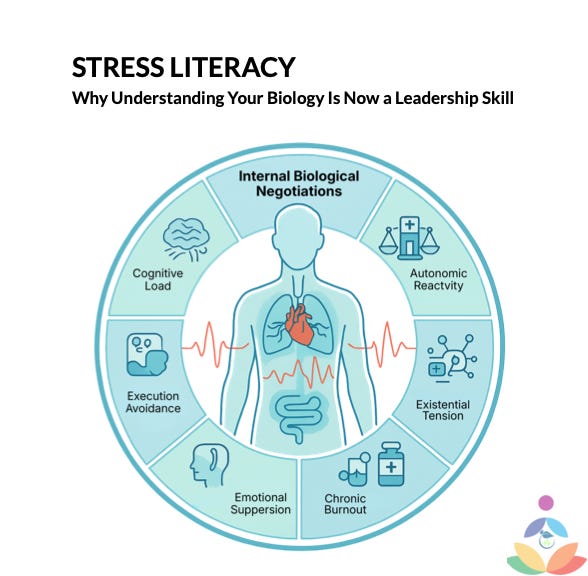
Six Stress Patterns, Not Personality Types
The paper also identifies six recurring stress patterns.
These are not traits.
They are adaptive responses the body uses to cope when load exceeds recovery.
-
Cognitive Load
-
Execution Avoidance
-
Emotional Suppression
-
Autonomic Reactivity
-
Chronic Burnout
-
Existential Tension
These patterns repeat across populations.
They describe how stress is carried, not who a person is.
Execution Avoidance, for example, is often mislabelled as procrastination.
In physiology, it frequently reflects a system limiting action because internal load exceeds recovery capacity.
Burnout is not the start of this story.
It is one of the outcomes.
What This Paper Is (and Is Not)
This is not a self-help guide.
It is not a diagnostic manual.
It is not a clinical trial.
It is a synthesis framework, drawing from physiology, neuroscience, field observation, and systems thinking.
Its purpose is to give practitioners, founders, and leaders a shared language for understanding stress as biology.
How This Series Will Unfold
This white paper is the foundation.
In the coming weeks, this publication will explore individual stress patterns in depth:
-
Burnout
-
Emotional Suppression
-
Execution Avoidance
-
Autonomic Reactivity
-
Cognitive Load
-
Existential Tension
Each piece will stand alone.
All of them trace back to the same map introduced here.
Accessing the White Paper
This paper is most useful when something feels off, but hard to name.
It is not meant to be read once.
It is meant to be returned to, especially before stress becomes visible or disruptive.
The full Stress Literacy White Paper is available here:
Closing note
Stress literacy does not make life easier.
It makes it clearer.
And clarity changes when and how systems recover.