
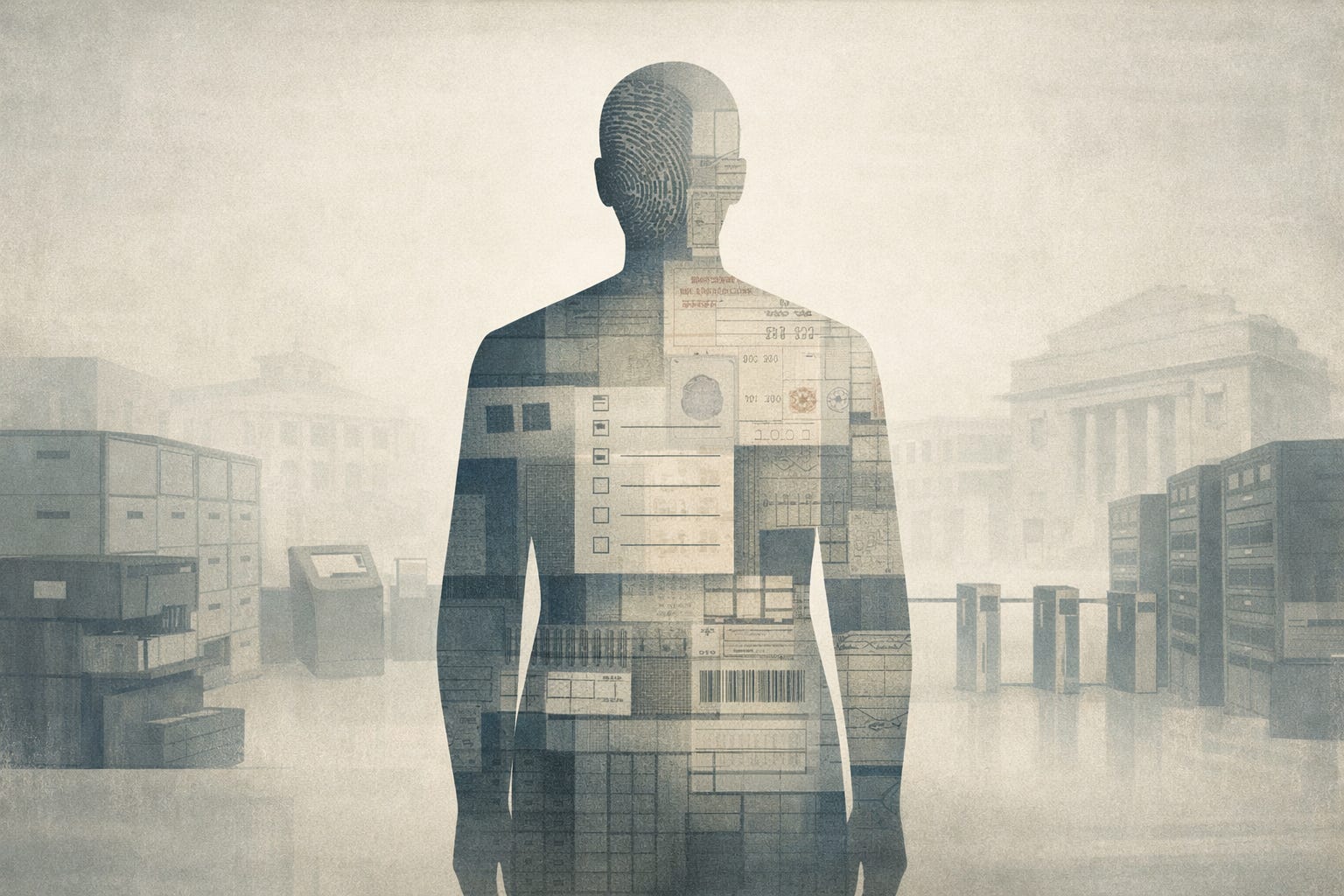
This piece has been developing over time, alongside earlier essays on wellness, religion, and death. It examines identity not as ideology, but as infrastructure – a system that now performs economic work across state, market, and everyday life.
This is not an argument for or against identity categories.
It is an examination of what happens once they become economic rails.
A conversation I wasn’t expecting
Mr X: Ajay, do you know why smaller families often pay more for childbirth?
Me: What? Never heard of this.
Mr X: It’s not written anywhere. No hospital will say it. But watch what happens.
Me: Go on.
Mr X: When a family plans one child, maybe two, that birth carries the entire future.
There are no second chances.
So the tolerance for uncertainty drops.
Me: Meaning?
Mr X: Every delay feels dangerous. Every ambiguity feels unacceptable.
Intervention starts to feel like safety.
Me: So more tests. More monitoring.
Mr X: And very often, surgery.
Me: A C-section.
Mr X: Yes. Not because something is wrong.
But because certainty is being purchased.
Me: But hospitals don’t charge by family size.
Mr X: They don’t need to. They price behaviour.
Me: Same biology. Different bill.
Mr X: Same delivery room. Different economics.
Me: So the cost isn’t about medicine.
Mr X: It’s about how much uncertainty you can afford.
Me: And that’s shaped by who you are.
Mr X: By how many chances you think life gives you.
From childbirth to identity economics
This isn’t about hospitals gaming patients.
And it isn’t about religion or policy.
It’s about how markets price predictability.
Pricing rarely follows identity directly.
It follows behaviour under uncertainty.
But behaviour isn’t individual.
It’s shaped by belonging;
family size, class, education, experience, and expectation.
Identity tells the system how predictable you are.
Predictability makes pricing possible.
That is the business of identity.
The pattern repeats
The same logic appears elsewhere.
Families with one child spend more on schooling;
not because schools cost more, but because failure feels final.
Weddings for “only children” escalate faster:
not because tradition demands it, but because visibility carries risk.
First-generation professionals overpay for coaching;
not because learning is scarce, but because uncertainty is.
When chances are few, certainty becomes expensive.
Belonging doesn’t change tariffs.
It changes tolerance.
And tolerance is what markets actually price.
The first declaration
Most Indians encounter this logic long before a delivery room.
The form is routine.
Name.
Date of birth.
Address.
Then comes the familiar column.
Nationality.
Religion.
Category.
Before skills.
Before interests.
Before intent.
You cannot proceed without choosing.
Identity is not something you discover.
It is something you declare.
What happens next is rarely examined.
That declaration travels;
across forms, databases, platforms, and markets;
quietly turning belonging into classification,
classification into predictability,
and predictability into revenue.
Identity was once social infrastructure
Now it is economic infrastructure
For centuries, identity in India functioned as context.
It shaped marriage, occupation, worship, inheritance.
It determined proximity and possibility.
You did not buy identity.
You were born into it.
Liberalisation did not erase this structure.
Digitisation did not flatten it.
Platforms did not disrupt it.
They instrumentalised it.
Identity moved from
background → market segment
belonging → targeting variable
lived reality → data layer
Today, identity is not just who you are.
It is how you are priced, profiled, serviced, and persuaded.
Identity is not one market
It is a stack of markets
There is no single “identity economy.”
There is an identity stack: overlapping systems that extract value from different forms of classification: social, aspirational, diagnostic, and administrative.
Together, they form a multi-lakh-crore invisible economy, spanning the state, private platforms, and everyday consumption. These figures are directional, drawn from fragmented industry estimates; the scale matters more than precision.
1. Inherited identity markets
(Caste, religion, region, language)
These are the oldest and most stable segments.
They power industries that rarely acknowledge their dependence on identity.
Matrimonial platforms
India’s organised matchmaking industry is estimated at ₹16,000 – 20,000 crore annually.
Profiles are filtered first by caste, religion, language, and sub-community.
Compatibility comes later.
Endogamy is sold as “preference.”
Filtering is monetised as premium access.
Coaching and exam preparation
India’s test-preparation industry is valued at $6 – 7 billion, projected to cross $20 billion by the early 2030s.
Government exams are not just career pathways.
They are identity-mobility mechanisms:
-
caste uplift
-
class transition
-
social legitimacy
Coaching centres sell a promise older than the republic:
become someone else.
The religious economy
Pilgrimage, rituals, donations, temple trusts, religious media, and tourism together generate economic activity estimated in the range of ₹4 – 5 lakh crore annually.
Faith here is not abstract belief.
It is logistics, queue management, real estate, broadcast rights, and cash flow.
These markets do not ask who you want to become.
They ask where you belong.
2. Constructed identity markets
(Gender, beauty, aspiration, nationalism)
These identities are not inherited.
They are manufactured and reinforced.
Beauty and personal care
India’s beauty and personal care market exceeds ₹1.5 lakh crore.
Despite cosmetic changes in language, the core signals remain intact:
-
skin tone
-
gender norms
-
desirability
-
respectability
Products sell acceptance before performance.
Women-centric consumption
Femtech, menstrual care, hormone health, wellness, and nutrition together form a ₹40,000+ crore ecosystem.
Empowerment is the vocabulary.
Consumption is the mechanism.
Symbolic nationalism
Patriotic aesthetics now permeate FMCG, media, tourism, and political fundraising.
The nation is no longer just an idea.
It is a brand surface.
These markets sell who you should be,
and what you must buy to get there.
3. Performative identity markets
(Founder, creator, hustler, spiritual seeker)
This is where identity becomes content.
The creator economy
India’s creator economy is valued at ₹19,000 – 25,000 crore, growing rapidly across platforms.
Authenticity is monetised.
So is vulnerability.
So is aspiration.
Coaching, courses, and masterminds
Business, mindset, spirituality, and productivity coaching together form a loosely regulated ₹10,000+ crore grey market.
Credentials matter less than narrative authority.
Identity does the selling.
You do not just learn.
You perform who you are becoming.
If performative identities are chosen and maintained by individuals, administrative identities are imposed, maintained, and audited by the state.
4. The administrative identity economy
(Aadhaar, passports, PAN, voter IDs, digital identity)
This layer is often invisible because it is normalised.
But it may be the largest and most expensive identity system of all.
India runs one of the world’s most extensive identity infrastructures:
Aadhaar, PAN, voter IDs, passports, ration cards, state-level IDs, and now multiple digital identity layers.
Each identity requires:
-
enrolment
-
verification
-
documentation
-
databases
-
updates
-
grievance redressal
-
security
-
periodic redesign
This is not a one-time cost.
It is a permanent administrative economy.
The cost of legibility
Running national identity systems involves:
-
tens of thousands of crores in infrastructure and technology
-
recurring staffing and servicing costs
-
continuous upgrades driven by fraud, scale, and political demand
Every error creates downstream costs:
-
exclusion
-
duplication
-
litigation
-
welfare leakage
-
political backlash
Identity is expensive not because it exists,
but because the state must constantly prove it works.
From citizen to record
Administrative identity turns people into entries, categories, and eligibility conditions.
Legibility enables governance.
It also enables extraction.
Once an identity exists, markets plug into it—banks, insurers, platforms, advertisers, employers.
The state builds the rails.
The market runs the traffic.
Who enables the identity economy
This system does not belong to a single actor.
It is enabled by:
-
government forms and databases that require categorical self-definition
-
ed-tech and coaching companies that segment aspiration
-
matrimonial platforms that productise endogamy
-
advertising and social media systems that cluster belief and behaviour
-
wellness and diagnostic startups that convert symptoms into profiles
No one controls the system.
Everyone profits from legibility.
No one owns the consequences.
Identity does not sell products
It sells certainty
Across all layers, the transaction is the same.
You are not confused.
You are this kind of person.
You are not struggling.
You are misaligned with your identity.
Markets do not resolve uncertainty.
They stabilise it just enough to monetise it.
Platforms did not invent identity politics.
They indexed it.
Algorithms reward strong labels, clear sides, and emotional certainty.
The more fixed your identity,
the more predictable your behaviour.
Predictability is profit.
The hidden cost of identity economies
Identity markets scale by fixing people in place.
Fluidity breaks segmentation.
Evolution reduces margins.
So identities harden.
Over time:
-
exploration becomes disloyalty
-
nuance becomes noise
-
change becomes threat
The system does not want you free.
It wants you recognisable.
When identity hardens, regulation becomes harder.
The nervous system adapts by narrowing.
Belief becomes defensive.
Stress becomes chronic.
This is why identity economies and stress economies grow together.
Why this matters to the belief economy
Wellness, religion, death, education, governance,
all now depend on identity infrastructure.
Identity decides who is trusted, who is visible, who is heard, who is ignored.
It is the operating system beneath belief.
And it is being optimised for extraction.
A closing provocation
If identity is now an economy, ask yourself:
Who designs the categories?
Who maintains the databases?
Who profits when identities harden?
Who pays when they fail?
Because in modern India,
the most expensive thing a nation maintains
is not roads or defence.
It is who its citizens are allowed to be.
Sources & Reading
Sources are provided for verification and further reading. This essay is not intended as an academic paper.
Market & Policy Sources
Census of India
KPMG India & RedSeer Consulting (Education & Test Prep, Matrimonial Services)
Ministry of Tourism (Religious & Pilgrimage Tourism)
FICCI & IMARC Group (Beauty & Personal Care)
NITI Aayog & RedSeer (FemTech & Women’s Health)
IAMAI & RedSeer (Creator Economy)
WHO & NIMHANS (Mental Health in India)
Conceptual Lenses
Pierre Bourdieu (Distinction)
Arjun Appadurai (Modernity at Large)
James C. Scott (Seeing Like a State)
Shoshana Zuboff (The Age of Surveillance Capitalism)
Satish Deshpande (Contemporary India)
C. A. Bayly (Empire and Information).
If this essay raised questions, earlier pieces in this series explore adjacent parts of the same system.