
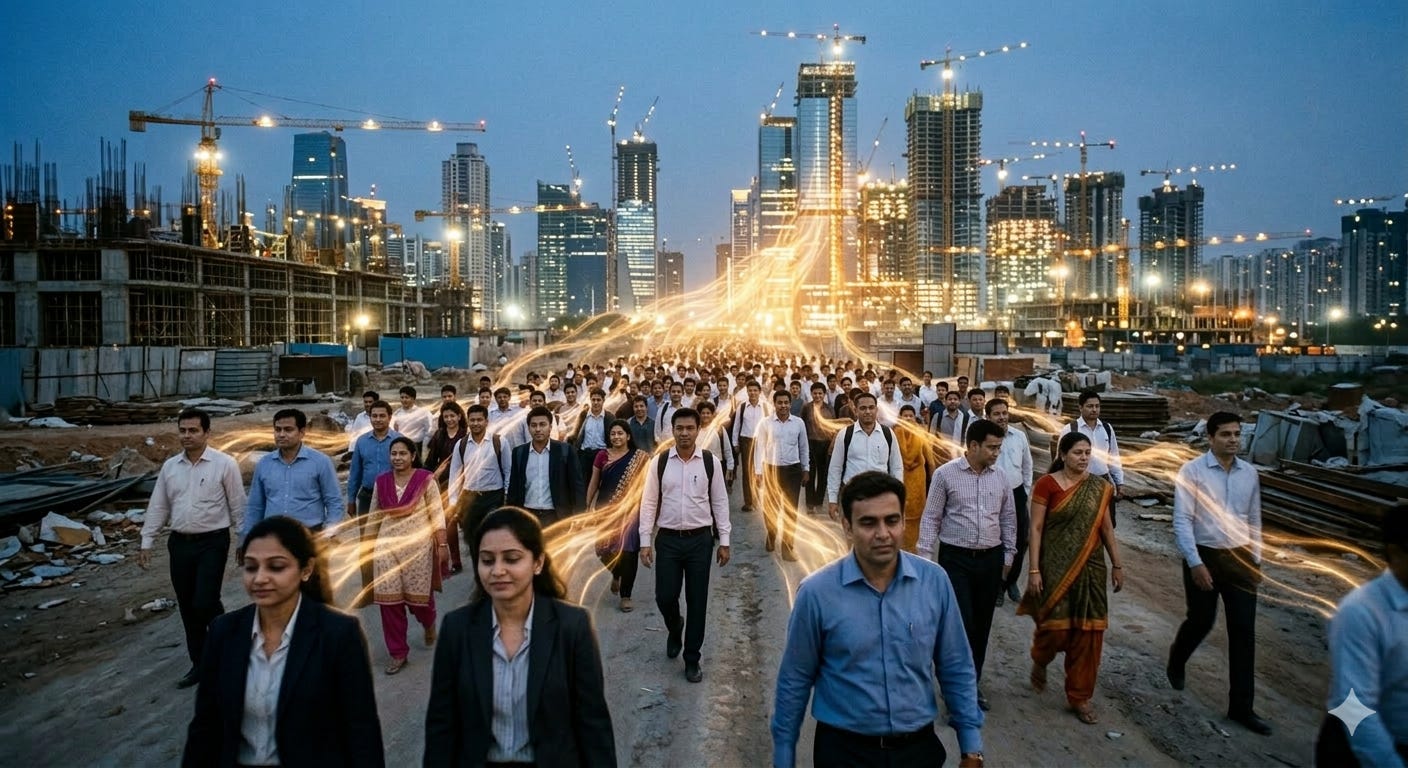
A Scene From the Stage
New Delhi. February 2026. Bharat Mandapam.
Prime Minister Modi at the podium.
Sam Altman to one side.
Dario Amodei to the other.
Sundar Pichai in the hall.
Demis Hassabis. Emmanuel Macron.
The UN Secretary-General.
250,000 registered attendees.
The India AI Impact Summit. $277 billion in investment pledges announced across five days. A Guinness World Record for AI responsibility pledges collected in twenty-four hours.
On stage: the arrival narrative.
India as aspiring superpower.
Global capital as partner.
Growth as the proof of both.
Not on stage: the people who will build the infrastructure,
train the models, deliver to the data centres,
pay the taxes, and supply the groundwater.
India has 18 percent of the world’s population.
It has 4 percent of its freshwater.
That number was not in the ledger.
This chapter maps what is in the ledger, what is not, and the belief system that keeps the two columns from being read together.
The Belief System
Every economy operating at sustained intensity requires a belief system.
Not enforcement – belief.
Enforcement is expensive, visible, and regulatable.
Belief is self-sustaining and invisible to the people inside it,
because it has been internalised as identity rather than experienced as pressure.
The belief system running India’s knowledge economy rests on four articles.
Most people building inside this system will recognise all four; not as external observations, but as the operating assumptions they wake up with.
Work equals worth.
Hours are a moral signal. Productivity is the primary measure of a person’s value, not just their economic output.
Suffering signals seriousness. Visible sacrifice is evidence of commitment. The person who does not show cost is not credible to investors, to peers, to the family watching.
Ambition is duty. Striving is connected to family obligation and national project simultaneously. Slowing down is not a personal choice, it is collective betrayal.
Recovery is maintenance. Rest exists to enable more work. Sustained recovery as a value in itself, a non-negotiable rather than a reward, has no place in the framework.
In October 2023, Infosys founder Narayana Murthy argued publicly that young Indians should work seventy hours per week as an expression of national commitment (Economic Times, October 2023).
The response from other prominent industry figures was not challenge. It was escalation. The All India IT and ITeS Employees’ Union noted that seventy-hour weeks exceed the Indian legal maximum of forty-eight hours. The observation had no enforcement consequence.
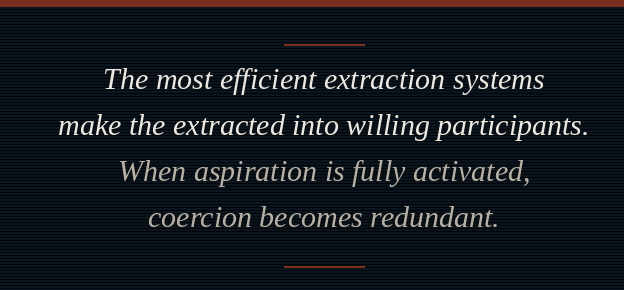
What the Data Records
Before mapping the six layers, the biological baseline for the workforce inside them:
-
62% vs 20% globally – burnout rate, Indian employees vs global average (CII-MediBuddy, 2024)
-
59% – Indian respondents reporting burnout symptoms, highest across 30 countries (McKinsey Health Institute, 2023)
-
47 hours – India’s average working week, highest in Asia-Pacific, above China, Japan, South Korea, and the United States (ILO)
-
1 in 4 – tech workers clocking 70+ hours per week regularly
-
745,194 – deaths globally in 2016 from overwork-related cardiac and stroke events (WHO/ILO Joint Estimates, 2021)
-
3.42× – higher stroke risk for men born in the 1980s versus those born in the 1930s, controlling for conventional risk factors (Menon et al., The Lancet Global Health, 2018)
Indians develop cardiovascular disease a decade earlier than Western peers. Cardiovascular disease now accounts for 45 percent of all deaths in the forty-to-sixty-nine age bracket.
India has no sector-specific occupational mortality data. No cardiac surveillance by profession. Every death is recorded as individual. Individual deaths do not, without a common denominator, constitute a public health statistic.
Several of the names below appeared in the LinkedIn feeds of the people reading this chapter. Each was called a tragedy. None triggered a sector-level occupational health investigation.
There is no official count of how many others were not prominent enough to be named.
Five founders. Thirty-seven months. All cardiac arrest. None with publicly disclosed cardiac histories.
Pankhuri Shrivastava · 32 · December 24, 2021 Sequoia-backed founder. Second company in build.
Ambareesh Murty · 51 · August 7, 2023 Pepperfry co-founder. $500M valuation.
Rohan Malhotra · 36 · October 1, 2024 Good Capital co-founder. Google-acquired portfolio.
Rohan Mirchandani · 42 · December 21, 2024 Epigamia founder. Middle East expansion in planning.
Amit Banerji · 44 · January 6, 2025 Table Space CEO. $2.5B IPO in preparation.
There is no official count of how many others were not prominent enough to be named.
Six Layers, One Substrate
The same architecture operates across six layers simultaneously:
A belief that makes participation feel like opportunity, structural conditions that constrain genuine exit, a statistical system that prevents cost aggregation.
All six draw from the same population.
Layer 1 — The Knowledge Economy
India’s IT and BPM sector generates $194 billion in annual export revenue (NASSCOM, 2024).
The wage differential sustaining this; 70 to 80 percent below equivalent US wages. This reflects genuine differences in purchasing power and domestic labour market conditions.
The question worth asking is whether it is also held in place by a cultural architecture that makes demanding better terms feel disloyal.
When the country’s most celebrated entrepreneur frames seventy-hour weeks as patriotism, the mechanism is not simply commentary. It attaches national identity to an economic model that prices Indian intellectual labour below its global market rate.
More so it makes the alternatives of organising, negotiating, reducing hours; feel like betrayal rather than a reasonable position. The person who accepts these terms is not coerced. They are convinced.
That distinction is the entire architecture.
Layer 2 – Venture Capital
India’s VC ecosystem received $13.7 billion in 2024 (Bain & Company, 2025).
The asymmetry embedded in every term sheet: an investor’s downside is financial; absorbed across a portfolio, managed by diversification.
A founder’s downside is biological. There is no portfolio management for a single body under sustained stress. That asymmetry has no line item in any funding agreement.
72 to 87 percent of founders globally report mental health difficulties.
Only 10 percent feel comfortable disclosing stress to investors; because the power dynamic of the funding relationship makes vulnerability a financial risk.
In London, Balderton Capital built a documented founder wellbeing programme after their own survey found 84 percent of founders felt expected to work excessive hours.
In India, what was reported in media were five founders died of cardiac arrest between 2021 and 2025, no comparable programme exists at the VC level.
The ecosystem mourned on LinkedIn and continued structurally unchanged.
Layer 3 – The Gig Economy
India’s gig workforce is projected to reach 23.5 million by 2030 (NITI Aayog).
The partner classification defining this workforce strips minimum wage protections, accident compensation, and the right to organise — experienced not as a policy design, but as the natural condition of self-employment.
On New Year’s Eve 2025, 200,000 to 300,000 gig workers struck simultaneously, the largest coordinated gig action in India’s history.
Workers chose collective action over a ₹6,000 peak-hours incentive.
The CEO of one platform: a system genuinely unfair to workers would not consistently attract them.
The union: 7.5 million orders were delivered that night because workers cannot afford to log out, not because the terms are just (Fairwork India, 2024).
That exchange is the belief system, rendered in two sentences.
Layer 4 – The Creator Economy
India has 3.5 to 4.5 million content creators (Kofluence, 2024–25).
88 percent earn less than 75 percent of their income from the platform. The belief being sold: the audience is an asset. The structural reality: the audience belongs to the platform’s database. When Instagram shifted algorithmic priority to Reels in 2024, creators who had built audiences on other formats saw reach collapse — not because the audience left, but because the platform redirected its traffic. The asset was always revocable. The creator supplied the labour. The platform kept the relationship.
Layer 5 – The AI Economy
India has 100 million weekly ChatGPT users.
AI systems increasingly perform tasks previously carried out by human engineers. NITI Aayog’s own projections suggest the tech sector workforce could contract by 1.5 to 2 million by 2031 (NITI Aayog AI Roadmap, October 2025).
TCS announced 12,000+ job cuts in 2025 citing automation. 68 percent of Indian IT workers fear their roles could be automated within five years — while 96 percent actively use AI tools in their daily work.
The geometry: Indian engineers at Indian wages contribute to AI capabilities incorporated into products sold globally at Western prices. The intelligence encoded in those systems generates returns for companies incorporated abroad. The worker who contributed to that encoding is first in line for displacement by it.
At the AI Summit, Sam Altman was asked about data centre water consumption. He described the concerns as entirely without basis. India’s data centres are projected to consume 358 billion litres of water annually by 2030 — more than double today — in cities where aquifer extraction already exceeds permissible limits (CEEW, 2026; S&P Global).
Layer 6 – The State
In 2023–24, Personal Income Tax exceeded Corporate Income Tax for the first time since independence:
PIT ₹10.45 lakh crore, CIT ₹9.11 lakh crore (Government of India Budget Data).
The buoyancy of PIT is 2.61.
CIT’s is 1.08.
More than 90 percent of those returns are filed by salaried knowledge economy workers whose taxes are deducted at source – no planning flexibility, no avoidance options.
The same population receives 1.9 percent of GDP in health spending against an OECD average of 8–12 percent.
The mental health allocation is 0.05 percent of GDP against a treatment gap of 76–85 percent.
Total social spending: 7.6 percent of GDP. OECD average: 21 percent.
In the same period, the state eliminated angel tax, reduced capital gains rates, and offered twenty-year tax holidays to foreign data centre operators.
It has not enforced the forty-eight-hour working week its own labour law specifies.
It has not introduced sector-specific occupational health surveillance.
It has not finalised a data centre environmental policy circulating in draft since 2020.
When Anna Sebastian Perayil, 26 years old, four months into her first professional role – died in July 2024, the Finance Minister advised families to cultivate inner strength through prayer. The investigation promised in ten days produced no binding regulation. No fine was levied.
The fiscal record does not establish intent.
It establishes priority, consistently across multiple budget cycles, in the same direction.
The Missing Column
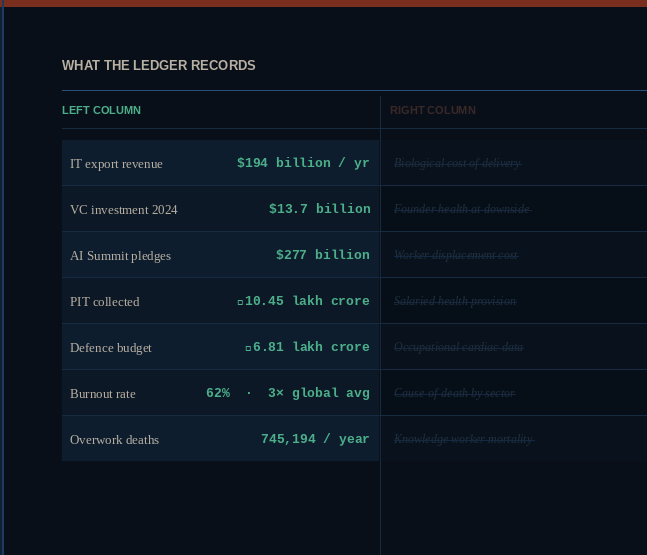
The ledger has two columns.
The left column is complete.
Revenue, investment, export earnings, tax collections, growth rate, summit pledges. Every number recorded, reported, and celebrated.
The right column is largely empty.
Biological cost, occupational mortality, sector-specific cardiovascular data, gig worker health outcomes, creator income distribution, AI displacement absorption costs, data centre aquifer drawdown,…
Countries with functioning occupational health surveillance track mortality by industry, working hours, and conditions as standard practice.
The US Bureau of Labor Statistics, the UK Health and Safety Executive, Germany’s BAUA, Japan’s Ministry of Health — all publish this data as a matter of course.
The infrastructure for building it exists.
The decision not to build it in India has been made consistently, across multiple administrations, in the same direction.
When costs cannot be aggregated, they cannot be regulated. When they cannot be regulated, the conditions that produce them continue undisturbed.
The right column can be measured.
The body keeps its own account with a precision the national statistics apparatus has chosen not to match.
Closing
The India Growth Story is real.
The export revenue, the professional middle class, the global engineering reputation, the poverty reduction across a generation; these are documented and measurable.
The question this chapter asks is not whether the story is true.
The question is whether the ledger recording it is complete.
Both columns exist whether they are officially recorded or not. The body keeps its own account. The aquifer registers its own drawdown. The cardiovascular system does not wait for official classification.
The war described in this series has no declared adversary, no border, and no armistice.
It has a ledger with one column missing.
References
CII-MediBuddy Corporate Wellness Report 2024.
McKinsey Health Institute Global Employee Survey, 2023.
UKG Workforce Institute Global Study, 2024.
WHO/ILO Joint Estimates of Work-Related Burden of Disease and Injury. 2021 Menon J et al. — The Lancet Global Health.
2018 Indian Heart Rhythm Society — Sudden Cardiac Death estimates.
India NASSCOM — IT Industry Annual Report, 2024 .
Bain & Company — India Venture Capital Report, 2025.
Government of India Union Budget 2023–24 and 2025–26.
SBI Research — Personal Income Tax composition and buoyancy analysis.
Centre for Financial Accountability — Tax structure analysis.
2024 NITI Aayog — Gig Economy Report and AI Roadmap.
October 2025 Fairwork India Report.
2024 Kofluence Annual Influencer Marketing Report.
2024–25 CEEW — Data Centre Infrastructure Report.
2026 S&P Global — Data centre water stress projections.
India TechPolicy.Press — India AI Impact Summit structural analysis.
February 2026 ILO — Working Hours Global Data, Asia-Pacific comparators.