

Stress Literacy – A Life is Biology Series
Stress Literacy is the ability to recognise how stress moves through the body before it becomes illness, burnout, or breakdown. This series treats stress not as emotion or mindset, but as a biological process, one that follows patterns, rhythms, and predictable system responses.
Each essay examines one recurring stress pattern seen across founders, professionals, and caregivers.
Cognitive Completion Stress describes what happens when the brain remains metabolically active because problems, decisions, and uncertainties never reach closure, even when the body has stopped working.
The Misunderstood Symptom
Cognitive Completion Stress rarely feels like stress.
It often feels like competence.
People experiencing it don’t usually describe anxiety or overwhelm. Instead, they say:
-
“I’m just thinking things through.”
-
“My brain is always on.”
-
“I like solving problems.”
-
“That’s just how my mind works.”
Modern work cultures reward this state. Continuous thinking is framed as intelligence, responsibility, and commitment, particularly in leadership, consulting, academia, entrepreneurship, technology and systems work.
The problem is not thinking itself.
The problem is that thinking never completes.
Cognitive Completion Stress Is Not Overthinking
Cognitive Completion Stress is often confused with overthinking, rumination, or worry. Biologically, it is different.
Overthinking implies excess thought.
Cognitive Completion Stress is defined by unfinished thought.
The brain evolved to operate in loops:
-
perceive
-
evaluate
-
decide
-
act
-
close
Closure matters because it signals that energy can be withdrawn. Without closure, neural circuits remain active, consuming glucose, oxygen, and attentional resources.
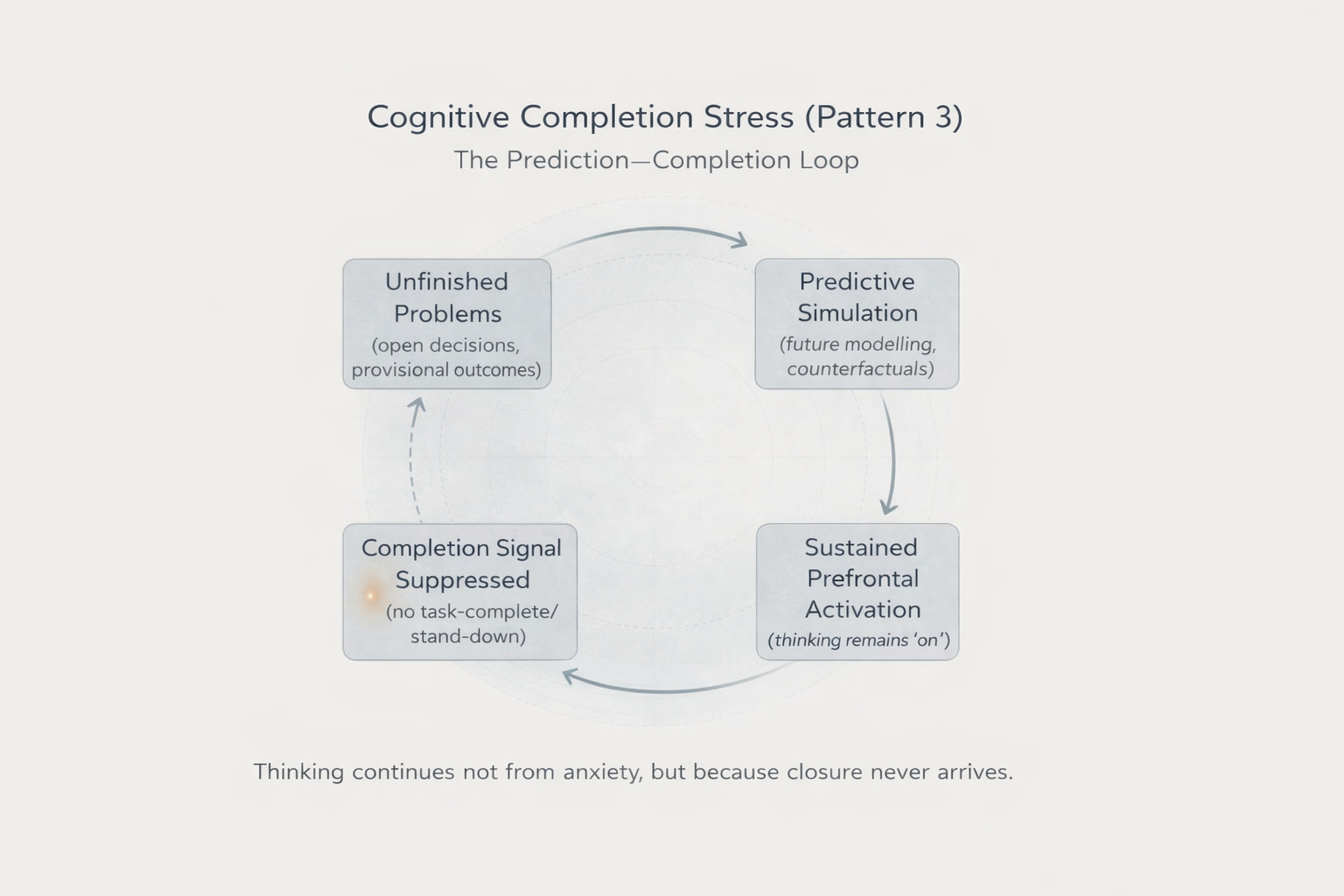
In Cognitive Completion Stress, the brain never receives a clear “task complete” signal, not because the person is indecisive, but because the environment keeps problems open:
-
decisions remain provisional
-
outcomes are delayed
-
responsibility persists
-
uncertainty is ongoing
Thinking continues not out of anxiety, but out of duty.
What We Mean by Stress
In everyday language, stress is often defined by pressure, workload, or emotional discomfort.
In Stress Literacy and in Lyfas, stress is defined differently.
Stress is a biological condition in which the body remains activated without sufficient recovery or return to baseline.
Activation itself is not stress.
Performance is not stress.
Thinking hard is not stress.
Stress emerges when biological systems remain engaged because they never receive a clear signal that demand has ended.
Cognitive Completion Stress qualifies as stress not because thinking is harmful, but because unfinished cognitive loops keep metabolic and autonomic activation running without resolution. The brain does not stand down because the work is never biologically marked as complete.
The Biology of Unfinished Thought
From a neurobiological perspective, sustained cognitive load involves persistent activation of the prefrontal cortex, the region responsible for planning, prediction, inhibition, and decision-making.
This activation is metabolically expensive.
Functional neuroimaging studies show that prolonged prefrontal engagement:
-
increases glucose utilisation
-
suppresses default mode network recovery
-
elevates cognitive fatigue even in the absence of physical exertion
Unlike physical work, cognitive work lacks clear sensory endpoints. There is no muscle fatigue signal, no visible completion, no immediate discharge.
The brain continues to simulate:
-
possible futures
-
alternative decisions
-
downstream consequences
This is not a psychological habit.
It is a predictive biological process.
A Note on Strategic Games and Unfinished Thought
Certain activities reveal Cognitive Completion Stress more clearly than most workplaces. Strategic games such as bridge (card game) and chess are among the cleanest examples.
In these games:
-
information is incomplete or hidden
-
every move opens multiple future branches
-
outcomes are delayed until the end
-
there is no safe point where the brain can disengage
Between moves, cognition continues, simulating opponents’ strategies, partners’ intentions, and alternative lines of play. There is no muscular discharge, no sensory marker of completion.
Even after the game ends, cognition often persists:
-
replaying missed opportunities
-
evaluating counterfactual decisions
-
refining internal models
These games are not demanding because they are competitive.
They are demanding because they require sustained prediction without closure.
Similar physiological patterns have been documented in roles such as air-traffic control, trading, military strategy, and emergency coordination; environments where the brain must remain active in the absence of resolution.
Strategic games simply make visible a core truth of cognitive biology:
The brain struggles not with difficulty, but with prolonged thinking that never receives a completion signal.
Decision Residue and Mental Saturation
Every unresolved decision leaves a trace.
Research on decision fatigue and decision residue shows that incomplete decisions continue to occupy working memory even when attention shifts elsewhere. The brain does not drop unresolved problems; it keeps them partially active.
Over time:
-
working memory becomes congested
-
cognitive flexibility declines
-
irritability increases
-
attention fragments
People often describe this as:
-
“mental clutter”
-
“too many tabs open”
-
“background noise in my head”
But the underlying mechanism is simple:
The system is saturated because nothing is allowed to finish.
Why Rest Doesn’t Restore Cognitive Completion Stress
One of the most confusing aspects of Cognitive Completion Stress is that rest does not restore it.
People may stop working, lie down, or take time off, yet their minds remain active. Sleep onset is delayed. Thoughts persist. Mornings begin with mental activity already underway.
This happens because rest reduces external demand, not internal prediction.
If cognitive loops remain open:
-
the prefrontal cortex stays partially engaged
-
default recovery networks fail to dominate
-
sleep becomes lighter and less restorative
The body is still.
The brain is not.
This pattern often precedes or coexists with Hypervigilant Stress and can gradually erode recovery capacity until Burnout appears.
These are not separate conditions, but different expressions of the same biological principle: sustained activation without release.
How Cognitive Completion Stress Shows Up in Real Life
Founders
The business lives continuously in the mind; strategy, cash flow, people, and risk are simulated even during rest. Thinking feels like care, stopping feels irresponsible.
Sole Business Owners
Thinking becomes the safety net. Errors feel personal. Delegation is limited. Mental rehearsal substitutes for control.
Business Leaders and Senior Professionals
Work becomes abstract and open-ended. Decisions ripple across systems. There are few clear endpoints. Problems evolve rather than conclude.
System Designers, Consultants, and Facilitators
Attention defaults to “what is wrong here.” Appreciation is replaced by analysis. Empathy gives way to logic. The same cognitive mode that excels in systems quietly struggles in relationships, where emotional completion and not cognitive resolution is required.
Across roles, the biological pattern is consistent:
-
high cognitive demand
-
low completion signals
-
deferred recovery
The Cost of Thinking Without Closure
Cognitive Completion Stress rarely causes immediate collapse.
Instead, it produces:
-
chronic mental fatigue
-
reduced creativity
-
emotional flattening
-
irritability without obvious cause
-
gradual erosion of satisfaction
People often remain highly functional and effective. They perform. They contribute. They lead.
But internally, something subtle is lost:
-
the ability to feel finished
-
the sense of arrival
-
the experience of mental quiet
Over time, this pattern commonly feeds into other stress states, not because the person is fragile, but because biology cannot sustain infinite open loops.
The Missing Signal
The brain cannot rest without resolution.
Cognitive Completion Stress is not a failure of intelligence or discipline. It is the cost of living in systems that rarely provide completion signals, and of roles that reward thinking without allowing it to end.
Until the body receives clear signals that work is done, decisions are closed, and responsibility has paused, recovery remains inaccessible – regardless of insight or intention.
Cognitive Completion Stress is what happens when thinking becomes continuous because nothing is allowed to finish.
References & Further Reading
McEwen, B. S. (2007). Physiology and neurobiology of stress and adaptation.
Arnsten, A. F. T. (2009). Stress signalling pathways that impair prefrontal cortex structure and function.
Raichle, M. E. (2015). The brain’s default mode network.
Smallwood, J., & Schooler, J. W. (2015). The science of mind wandering.
Baumeister, R. F., et al. (1998). Ego depletion: Is the active self a limited resource?
Damasio, A. (1994). Descartes’ Error.
Walker, M. (2017). Why We Sleep.
Rosa, H. (2013). Social Acceleration.
Han, B.-C. (2015). The Burnout Society.