

Stress Literacy – A Life is Biology Series
Stress Literacy is the ability to recognise how stress moves through the body before it becomes illness, burnout, or breakdown.
This series treats stress not as emotion or mindset, but as a biological process, one that follows patterns, rhythms, and predictable system responses.
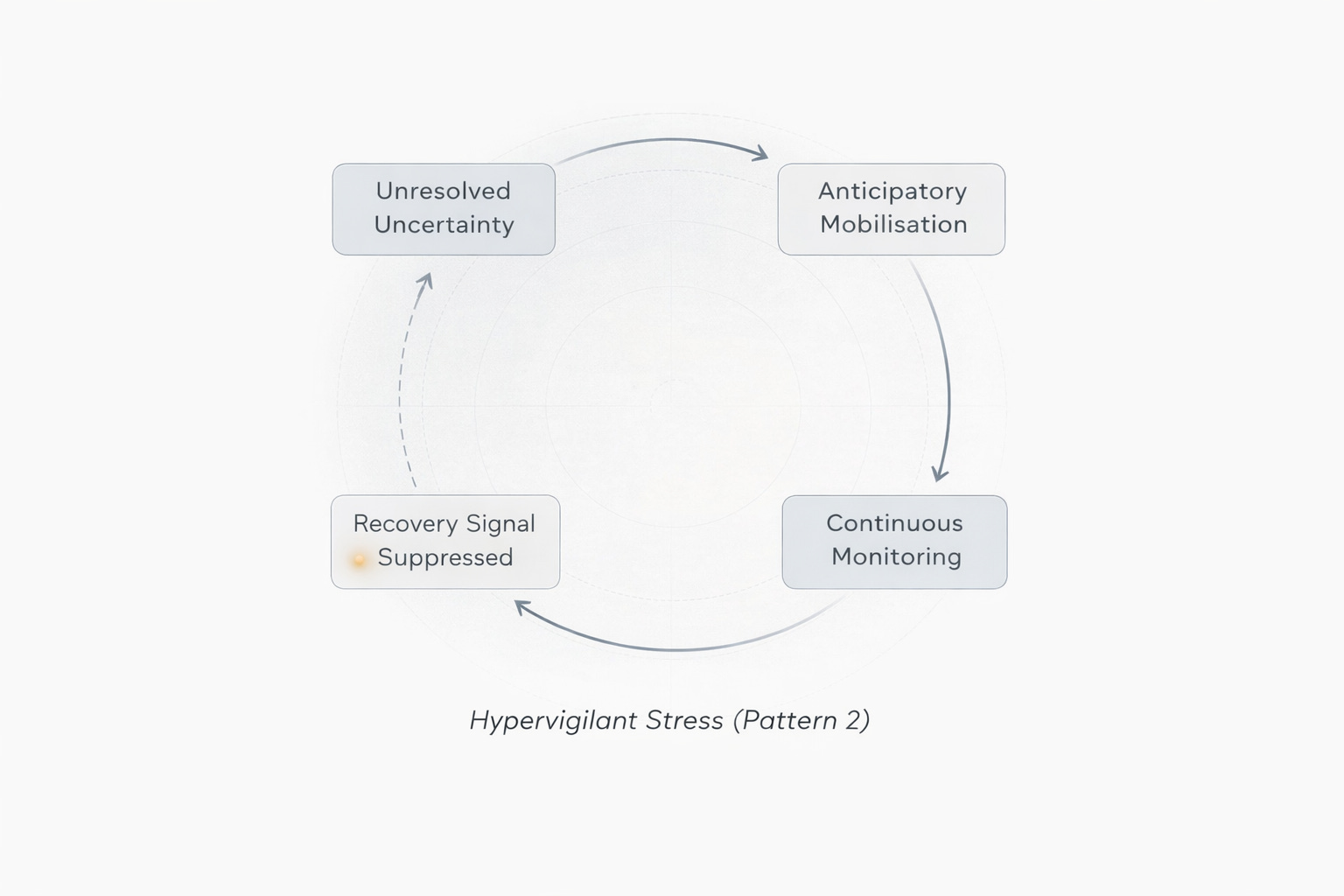
Each essay examines one recurring stress pattern seen across founders, professionals, and caregivers. Pattern 2 explores what happens when the body stays prepared for what might happen next, and why constant readiness can quietly erode recovery long before exhaustion appears.
Some stress feels like panic.
This one does not.
Hypervigilant stress is quiet, persistent, and often mistaken for competence. People experiencing it may appear functional, productive, even calm.
They may not describe themselves as anxious or overwhelmed. Many simply say they are “used to pressure.”
Biologically, however, something essential has been lost:
the ability to stand down.
Hypervigilant stress is not driven by fear in the psychological sense. It is driven by anticipation without resolution; a state in which the body remains prepared for threat long after action is no longer required.
In Stress Literacy terms, hypervigilance becomes stress not because the person feels afraid, but because the nervous system remains mobilised without receiving clear signals of safety or stand-down.
Vigilance Is Not a Malfunction
Vigilance is one of the oldest survival capacities in biology.
In predator-prey systems, vigilance allows an organism to scan, predict, and prepare before danger materialises.
It is metabolically expensive, but evolutionarily adaptive – as long as vigilance resolves.
Modern stress rarely resolves.
Threat today is often abstract rather than physical, symbolic rather than immediate, ongoing rather than episodic. Responsibility persists without closure. Risk remains distributed and undefined. Decisions multiply without clear endpoints.
The nervous system evolved for short bursts of anticipation followed by discharge. When anticipation becomes continuous, vigilance turns costly; not because it is excessive, but because it is never completed.
This is the biological foundation of hypervigilant stress.
From Homeostasis to Allostasis: A System That Predicts Constantly
Classical physiology assumed homeostasis: stability maintained by correction after disruption.
Stress biology operates differently. It functions through allostasis – predictive regulation. The brain does not wait for imbalance; it anticipates demand and reallocates energy in advance.
Bruce McEwen showed that this predictive control is efficient in the short term, but damaging when demands remain uncertain or unresolved.
Over time, the cost accumulates as allostatic load: wear across autonomic, endocrine, immune, and cognitive systems.
Hypervigilant stress is allostasis without recovery.
The body is not reacting to danger.
It is forecasting endlessly.
Neuroception: Why Safety Is Not a Thought
Stephen Porges introduced the concept of neuroception; the nervous system’s unconscious evaluation of safety, danger, or life threat.
Neuroception does not ask, “Am I logically safe?”
It asks, “Is it safe to stop monitoring?”
In hypervigilant stress, the answer is never clearly yes.
Even when circumstances improve; time off, reduced workload, supportive environments, the nervous system may continue to register unresolved risk.
Safety is not inferred cognitively. It is registered through rhythm, breath, voice, posture, predictability, and relational cues.
Without these signals, the system stays alert.
This is why reassurance fails.
This is why insight alone does not resolve the state.
Anticipation Fatigue and the Predictive Brain
Hypervigilance is often mistaken for overthinking.
In reality, it is prediction overload.
Contemporary neuroscience increasingly understands the brain as a predictive system, continuously modelling what will happen next and updating itself through error signals. When environments are unstable or ambiguous, error rates rise. The brain compensates by increasing monitoring.
Amy Arnsten’s work shows that chronic stress degrades prefrontal cortex regulation, shifting control toward faster, more rigid survival circuits. Thinking becomes effortful not because of inefficiency, but because resources are being diverted toward continuous prediction.
Mental fatigue in hypervigilant stress is not laziness.
It is the cost of never being allowed to stop anticipating.
Sleep as Continued Monitoring
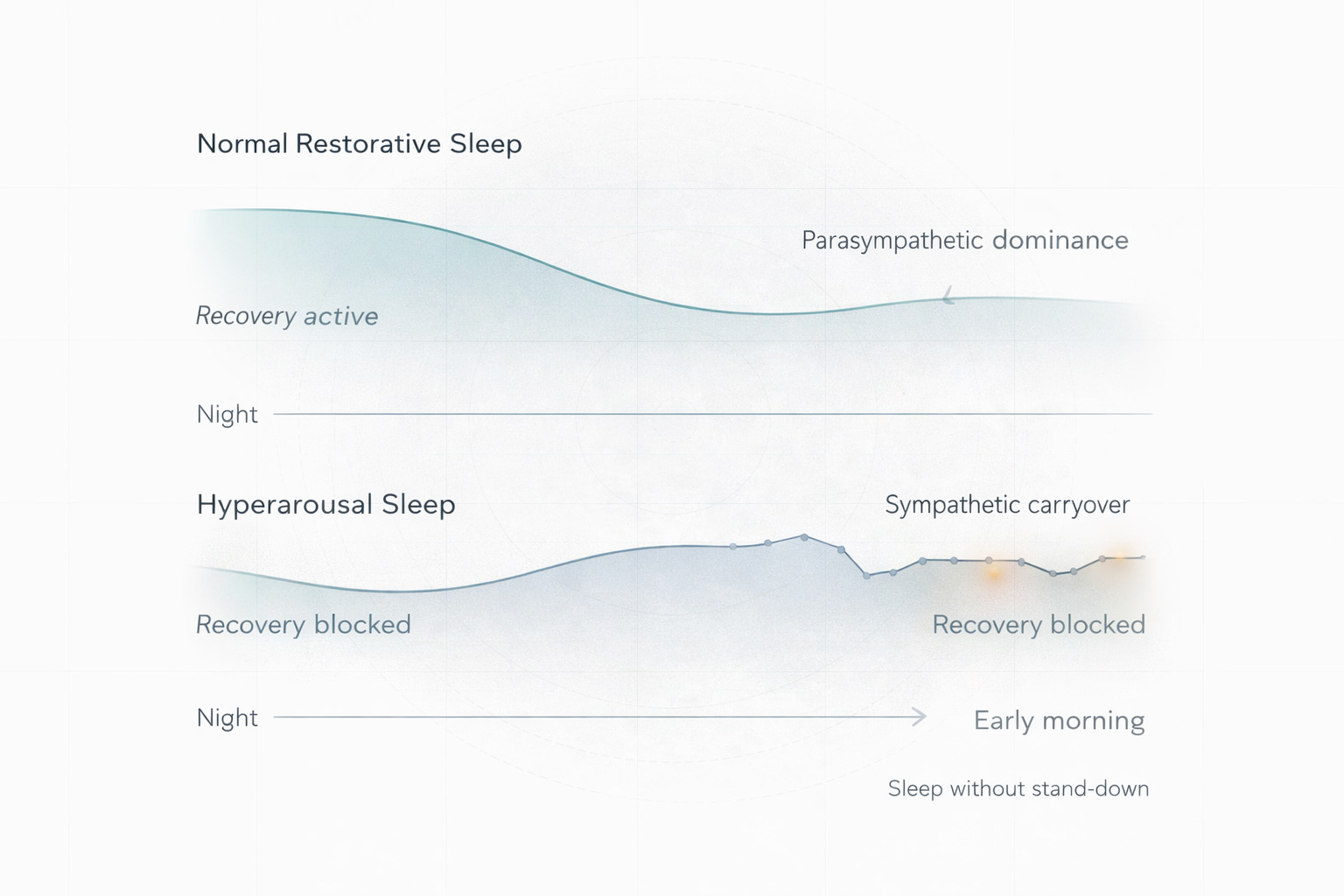
One of the clearest signatures of hypervigilant stress is non-restorative sleep.
People often report difficulty falling asleep despite fatigue, light or fragmented sleep, sudden awakenings, or waking already wired. Sleep researchers describe this as hyperarousal insomnia, elevated sympathetic activity persisting across sleep stages.
Matthew Walker’s work shows that REM sleep plays a key role in emotional recalibration. When REM is fragmented, emotional load accumulates. The system wakes already braced.
In hypervigilant stress, sleep is not recovery.
It is continued monitoring with reduced sensory input.
Roles That Train Vigilance
Hypervigilant stress concentrates in roles where standing down feels risky.
Founders live with unresolved responsibility: financial exposure, team dependence, identity fusion, and asymmetric consequence.
Caregivers carry constant monitoring and moral vigilance, often without relief or permission to rest.
In both cases, the nervous system learns a simple rule:
“If I relax, something important might be missed.”
This is not belief.
It is conditioning.
Over time, vigilance becomes normalised.
Calm feels unfamiliar.
Rest feels unsafe.
A Note on Surveillance and Behaviour
I once collaborated with a leadership development centre housed within a university and worked from their office for nearly two months. During that time, I noticed something subtle but consistent: staff were careful with words, restrained in movement, and unusually alert even during informal moments.
Only later did I learn that the entire facility was under continuous CCTV surveillance, and that everyone knew it.
What stood out was not anxiety or visible distress. It was how vigilance had already been absorbed into behaviour. Conversations were measured. Pauses were deliberate. Informal interactions carried an undertone of watchfulness.
Surveillance did not need to intervene actively. Its mere presence trained anticipation. The body learned to stay prepared – not for an immediate threat, but for the possibility of being observed, evaluated, or misinterpreted.
This is how hypervigilant stress forms in modern institutions:
not through danger, but through continuous visibility without safety signals.
Why Medicine Often Misses This Pattern
Hypervigilant stress rarely presents with pathology.
Blood tests return normal. Imaging is unremarkable. Standard mental health screens may show mild or inconsistent findings. Because collapse has not occurred, the system is considered healthy.
But rhythm has already eroded.
Autonomic markers: reduced heart rate variability, elevated resting heart rate, flattened day–night variation; often reveal dysregulation long before disease emerges. These signals are not routinely assessed.
The absence of disease is mistaken for the presence of health.
Culture as a Vigilance Amplifier
Modern systems systematically reward vigilance: digital notifications, performance tracking, always-on work cultures, and narratives that equate readiness with worth.
Sociologist Hartmut Rosa describes this as social acceleration – speed increasing while agency diminishes. Byung-Chul Han describes a burnout society in which self-exploitation replaces external coercion.
These systems do not cause hypervigilance.
They stabilise it.
Biology adapts accordingly.
Conclusion
Hypervigilant stress is not anxiety, ambition, or personality.
It is a biological state shaped by anticipation without resolution, a nervous system trained to prepare continuously because safety is never clearly signalled.
Until the body relearns when it is safe to stop monitoring, recovery remains inaccessible, regardless of insight, intention, or rest.
This pattern rarely announces itself loudly.
It becomes visible only when we learn to read rhythm rather than symptoms.
What happens when stress goes quiet instead of alert, and why containment can be just as costly, comes next.
Select References
McEwen, B. S. (2007). Physiology and neurobiology of stress and adaptation.
McEwen, B. S., & Stellar, E. (1993). Stress and the individual: mechanisms leading to disease.
Porges, S. W. (2007). The Polyvagal Perspective.
Arnsten, A. F. T. (2009). Stress signalling pathways that impair prefrontal cortex function.
Thayer, J. F., & Lane, R. D. (2000). A model of neurovisceral integration.
Shaffer, F., & Ginsberg, J. P. (2017). An overview of HRV metrics and norms.
Bonnet, M. H., & Arand, D. L. (2010). Hyperarousal and insomnia.
Walker, M. (2017). Why We Sleep.
Gross, J. J., & Levenson, R. W. (1997). Hiding feelings: physiological consequences.
Maté, G. (2022). The Myth of Normal.
Rosa, H. (2013). Social Acceleration.
Han, B.-C. (2015). The Burnout Society.