
Business of Belief series began with a question:
Why do the things that once gave us comfort – education, religion, love, success – now feel like transactions?
Why do we pay not just for what we want,
but also for who we are allowed to be?
📘 What This Series Is
The Business of Belief and Beyond explores the emotional, spiritual, and psychological scaffolding that sustains today’s economy – especially in India, but with global resonance.
It maps how belief, once a private compass, has become public currency; shaping how we learn, love, lead, worship, mourn, and dream.
From guru-streaming platforms to startup hustle coaches, from caste-based identity economies to the commercialisation of death – every chapter unpacks a system hiding in plain sight.
This series is not a manifesto.
It’s a lens.
Each chapter is a:
-
Business model
-
Cultural script
-
Survival strategy
Together, they form the belief-operating system of a modern, anxious society.
If you’re a builder, observer, or outsider trying to make sense of how meaning gets priced – this series is for you.
📊 The Scale of Belief
Taken together, the chapters in this series examine markets totalling over ₹35–40 lakh crore, engaging more than 100 crore consumers,
and employing upwards of 8–10 crore people directly or indirectly.
This isn’t just culture.
It’s infrastructure.
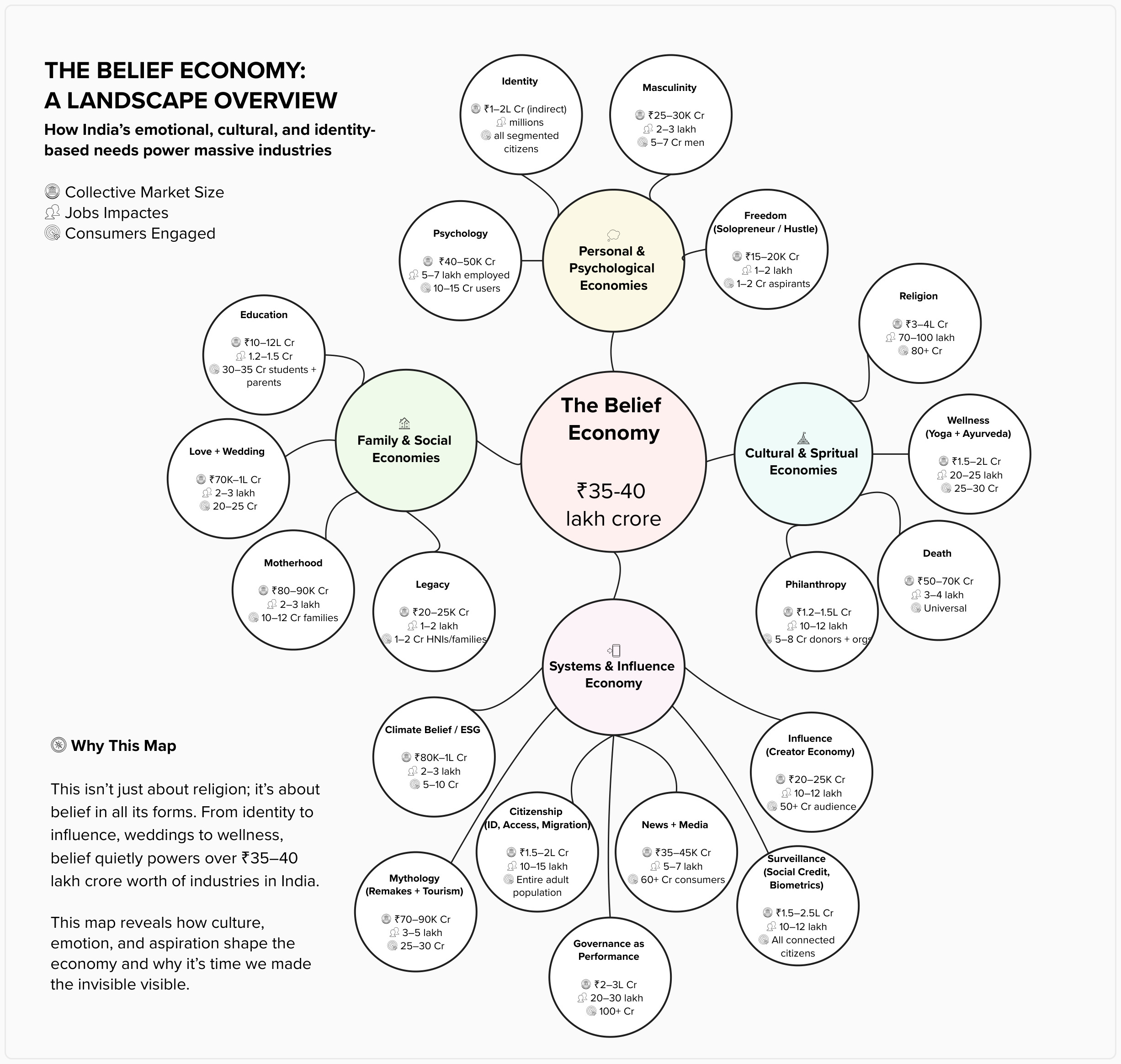
All market figures are indicative, not exhaustive.
Sectors overlap – someone using a meditation app may be part of the wellness, tech, and belief economy at once.Our goal isn’t precision accounting.
It’s systemic clarity.
🪔 Preface
Before there was money, there was belief
Long before balance sheets and startups, before borders and brands, human beings traded in stories. We whispered myths around fires, carved gods into stone, and followed leaders not for profit, but for purpose. Belief was our original currency—unquantifiable, yet more valuable than gold. And like all currencies, it could be exchanged, manipulated, or lost.
I. A SHORT HISTORY OF BELIEF
Thousands of years ago, belief held empires together. Ashoka’s Dhamma wasn’t just policy – it was soft power. The Bhakti movement moved people across caste lines. From ancient Egypt to Vedic India, belief built institutions: temples, libraries, warrior codes. But belief also burned people at stakes and etched borders into minds. It stitched together meaning and created division with the same thread.
Example: In 1893, Swami Vivekananda stood before a crowd in Chicago and invoked the unity of faiths. But back home in India, his words sparked not just inspiration – but competing sects, institutional ashrams, and a market of spiritual authority that still thrives today.
II. WHEN BELIEF BECAME BUSINESS
The industrial era turned gods into brands. The liberalisation of economies turned temples into GDP engines. A pilgrimage to Tirupati now rivals the passenger traffic of mid-sized airports. Gurus run IPO-worthy empires. And meditation, once a private ritual, is now a $4.5 billion global market.
Belief shifted, from a deeply personal compass to a professionally managed marketplace.
Example: A young tech worker, disillusioned with hustle culture, finds solace in a digital ashram app. He pays monthly for teachings, attends online Darshana, buys merch from the guru’s Shopify store and posts about spiritual detachment on Instagram. The irony isn’t lost on him, but the experience feels real.
III. WHY THIS SERIES NOW?
Because belief is no longer just about religion. It fuels edtech unicorns, underwrites wellness retreats, and powers billion-dollar election campaigns. The language may have changed; coaching, mindfulness, empowerment, nationalism, but the business model remains the same: monetise trust.
We live in an era where:
-
Coaches are the new priests.
-
Death is a subscription service.
-
Legacy is managed like a portfolio.
-
Identity is data.
Example: A startup founder hires a performance coach to optimise productivity. Sessions begin with breathing exercises and end with branding advice. Is it therapy? Religion? Leadership? The answer: it’s a service model built on belief: in self, success, and transformation.
IV. THE PROS AND CONS OF BELIEF
Belief gives hope. It binds families. It can heal, motivate, and mobilize. But belief also sells illusions. It feeds on fear. It simplifies the complex and markets it as certainty.
We don’t argue for or against belief here. We just follow the money.
Example: During the pandemic, cremation grounds in India ran out of space. Parallel to this tragedy, funeral tech startups were born – offering package deals, livestream rituals, and premium afterlife care. In a time of collective grief, belief found a business plan.
V. THE MAP AHEAD
Each chapter in this series investigates a different belief-driven economy:
-
Some are sacred (like religion or death).
-
Some are secular (like education or psychology).
-
Some are hybrid (like governance, climate, or citizenship).
Each is a business model, cultural script, and survival strategy.
If this sounds like anthropology with Excel sheets, you’re in the right place.
We’re not trying to sell you enlightenment.
We’re just showing you the invoice.
This isn’t a call for purity.
It’s a call for pattern recognition.
We’re not selling you enlightenment.
We’re just showing you the invoice.
This series is not a set of opinion posts. It is a systemic investigation. A map, across 20+ chapters, tracing how belief becomes economy.
The journey is structured into five parts:
I – The Inner Economies
Where personal meaning becomes commercial need
Your psychology, your sense of self, your autonomy—once personal—are now industries. This section unpacks how emotions, identity, masculinity, and the dream of “freedom” have all been productised.
II – The Family Economies
When care, love, and duty become transaction-driven
Marriage, parenting, inheritance, even education—once sacred or personal—now operate through financial scripts. What used to be tradition is now production. What used to be care is now code.
PART III — The Outer Economies
When institutions and ideologies become monetisable ecosystems
Religion, wellness, news, climate, and citizenship. These aren’t just public systems. They are belief markets. This section tracks how collective trust is engineered and sold, across temple corridors and ESG dashboards alike.
PART IV – The Systemic Economies
The infrastructure of control: surveillance, influence, and governance
This part dissects the invisible engines behind modern economies. Where platforms, governments, and corporations use belief as leverage to shape behaviour, compliance, and aspiration.
PART V – The Map Room
The architecture behind it all
The final chapter brings it all together. It’s not a conclusion. It’s the operating system. A visual grammar of how belief powers economies, silently but systematically.
🧩 What to Expect
Each chapter will be released as a deep-dive article; combining data, narrative, system design, and sharp provocations.
This isn’t an academic paper.
It’s a decoding manual.
📬 Subscribe to the Series
You’ll receive:
-
One long-form chapter each month
-
Cultural and economic breakdowns
-
Links to deep archives and visual maps
👇 Subscribe below to begin.