

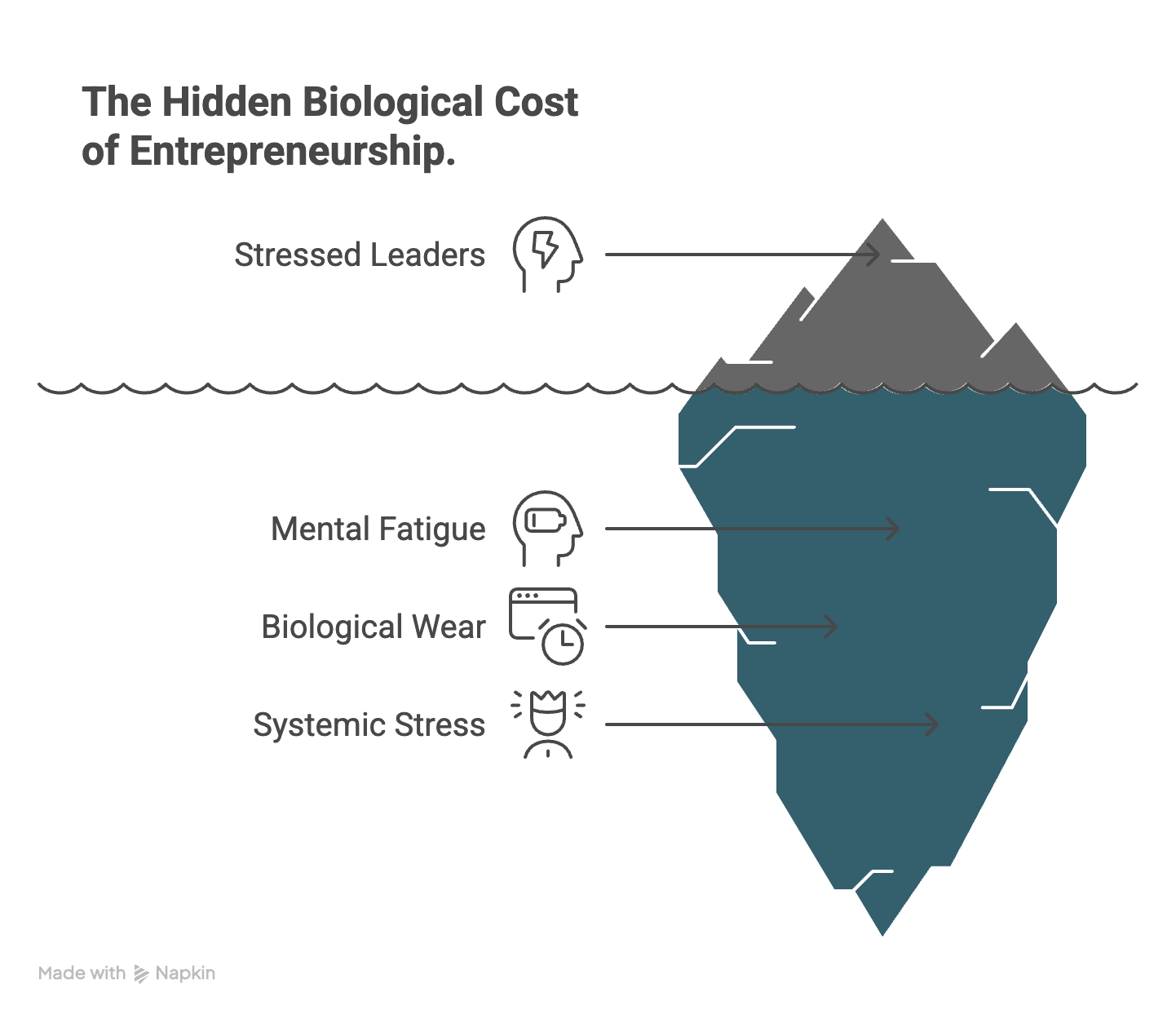
Founders, creators, and entrepreneurs pay a psychological price to pursue their dreams.
Driven to excel, they push through long nights, endless decisions, and the constant weight of uncertainty. But what often goes unnoticed is the cost: not just mental fatigue, but deep biological wear.
When we say “founder” here, we don’t only mean startup CEOs or business owners.
A founder is anyone who chooses the pursuit of excellence over the comfort of dependency; the artist who builds a body of work, the professional who creates new knowledge, the leader who builds from nothing. They are the ones who refuse to be carried by the system and instead create systems for others.
For all of them, stress is the silent tax of creation.
Most leaders say, “I’m stressed,” when what they really mean is “I’m anxious” or “I’m busy.” Yet stress is not just a mood. It is a biological event; a full-body shift that begins in the nervous system and ripples through every organ, cell, and thought.
The Biology of Stress
When we speak of the biology of stress, we mean the way a psychological experience: uncertainty, pressure, or fear is translated into chemistry, hormones, and cellular signals inside the body.
Stress is not an abstract idea; it is measurable in heart rhythms, inflammatory markers, glucose levels, and even the wear-and-tear of your DNA. It is the point where thought becomes biology.
But what is mind in this equation?
The mind is not just thought. It is the organising force that gives meaning, memory, and direction to experience.
Sri Aurobindo described the mind as a bridge; between spirit and body, between will and action.
In his words, “disease is the expression of a break in harmony, and harmony can be restored by the power of the inner will and the mind.”
The mind does not merely witness the body; it instructs it.
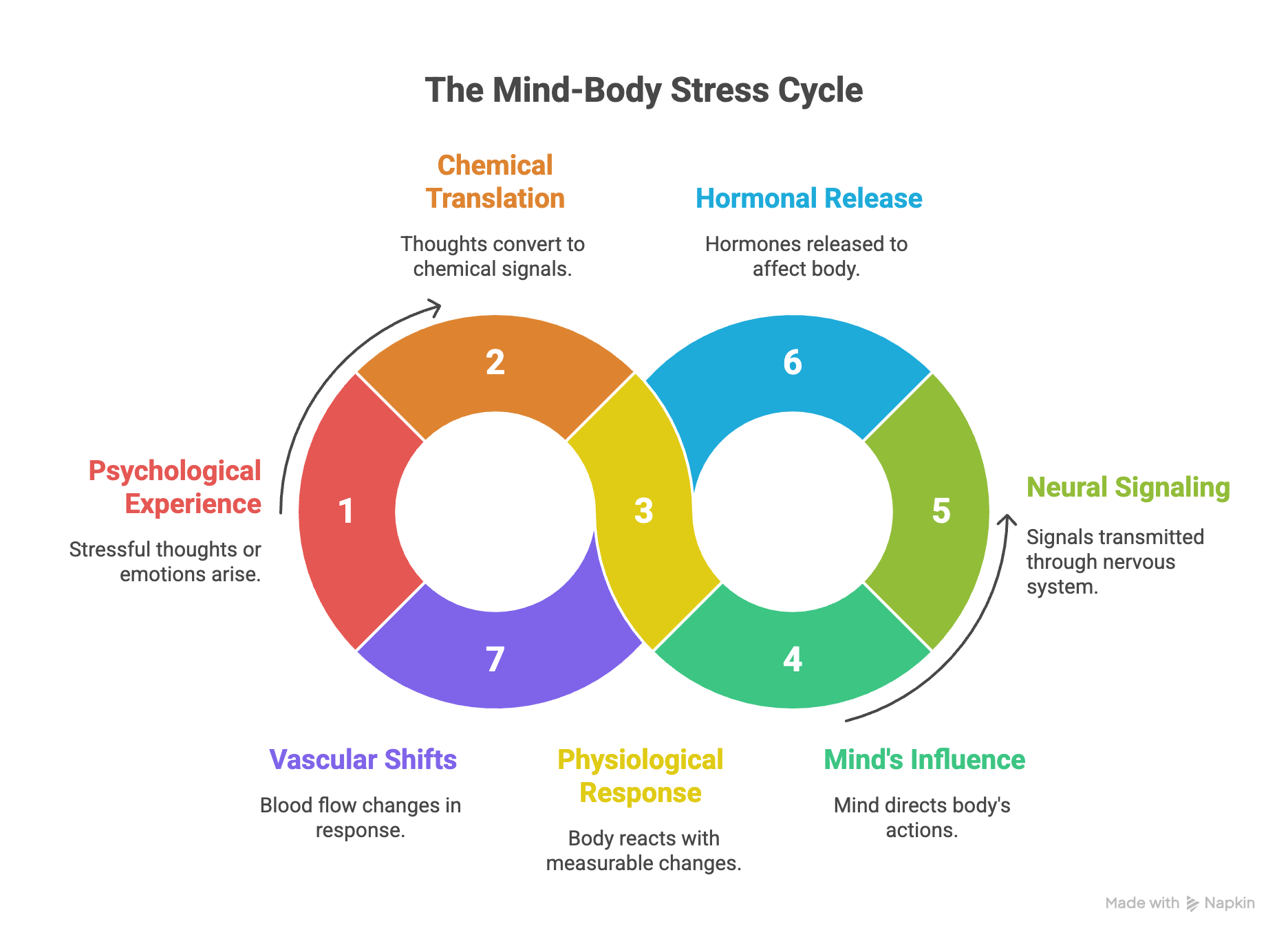
Modern physiology shows how this happens: the mind’s signals are carried by the nervous system. Every thought and decision, whether an investor pitch, a negotiation, or a creative breakthrough is translated into neural firing, hormonal release, and vascular shifts.
-
The Accelerator (SNS) – your sympathetic nervous system triggers survival energy: pitch, negotiate, fight fires.
-
The Brake (PNS) – your parasympathetic system restores balance: repair, digestion, and long-term resilience.
In a healthy rhythm, these two systems dance. In stressed founders, the accelerator gets jammed while the brake weakens.
On Lyfas scans, this imbalance shows up as:
-
Low HRV (heart rate variability)
-
Suppressed RMSSD (weakened emotional buffering)
-
Elevated LF/HF ratio (sympathetic dominance)
-
Reduced vagal tone (poor recovery potential)
This is the mind-nervous system bridge made visible. When harmony breaks at the level of thought and will, it translates directly into measurable strain in your biology.
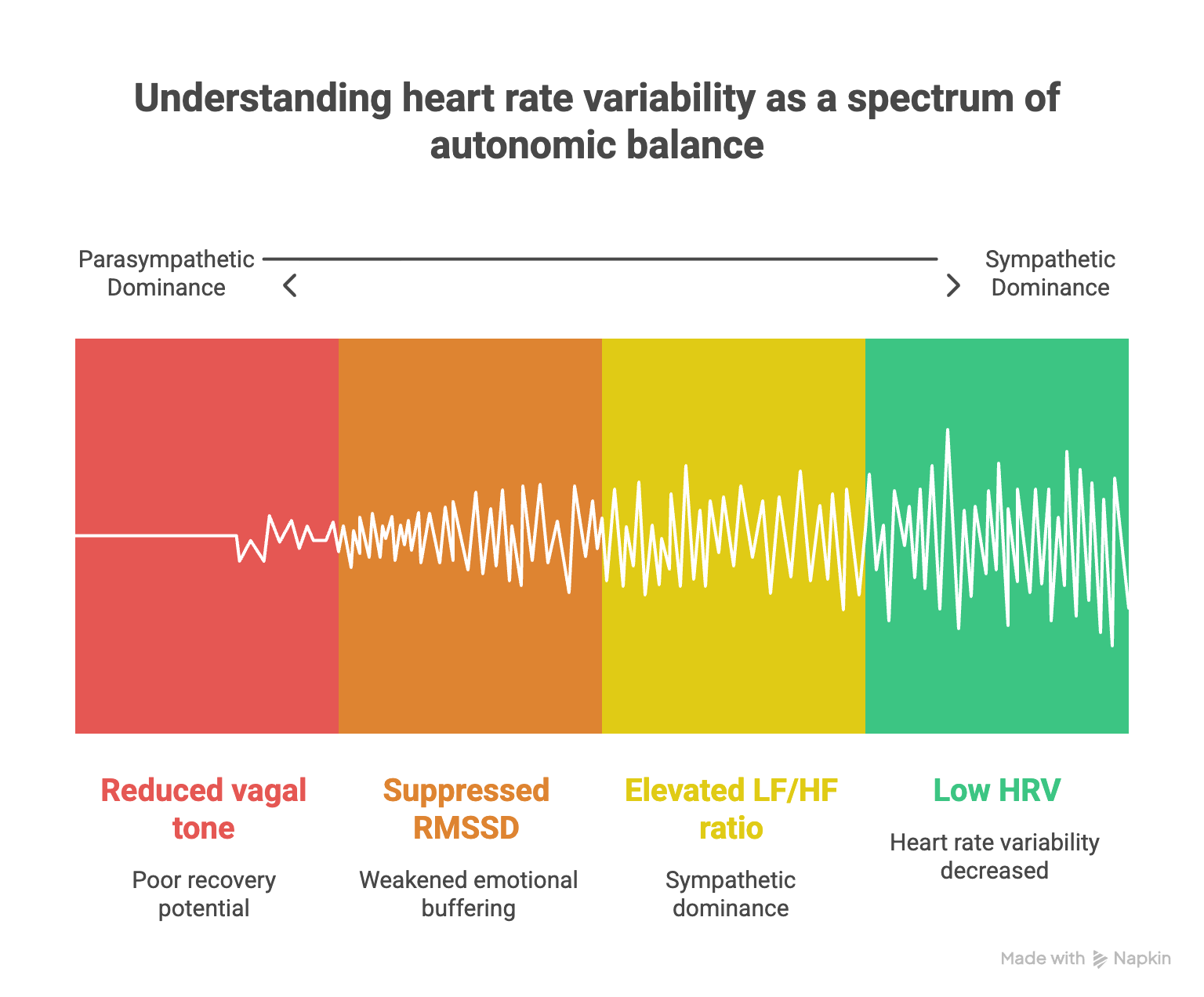
Stress, therefore, is not just “pressure.” It is your inner system revealing a loss of rhythm.
How Blood Work Reveals Stress Too
Your blood carries the fingerprint of stress, often before you feel it:
-
Elevated fasting glucose & HbA1c → cortisol keeps sugar high, even without diabetes.
-
High triglycerides & LDL → chronic stress shifts metabolism into “survival storage.”
-
Raised CRP (C-reactive protein) → inflammation sparked by overdrive.
-
Low Vitamin D & B12 → depleted repair reserves.
-
Flattened Cortisol/DHEA ratio → a marker of adrenal fatigue and burnout.
These are not random lab results. They are biological echoes of the same overdrive we see in the nervous system.
Why Founders Break Differently
Athletes collapse on the field. Founders collapse in silence — in their sleep, in a boardroom, or in the quiet of their minds.
-
Cognitive overload burns neurochemistry, not just time.
-
Emotional suppression leaves stress unprocessed, stored in the gut, heart, and immune system.
-
Invisible fatigue allows performance on the surface while systems underneath shut down.
That’s why strokes, heart attacks, and burnout in entrepreneurs feel “sudden.” They’re not. They’re accumulated stress surfacing at last.
The FSP-40: Mapping Your Stress Signature
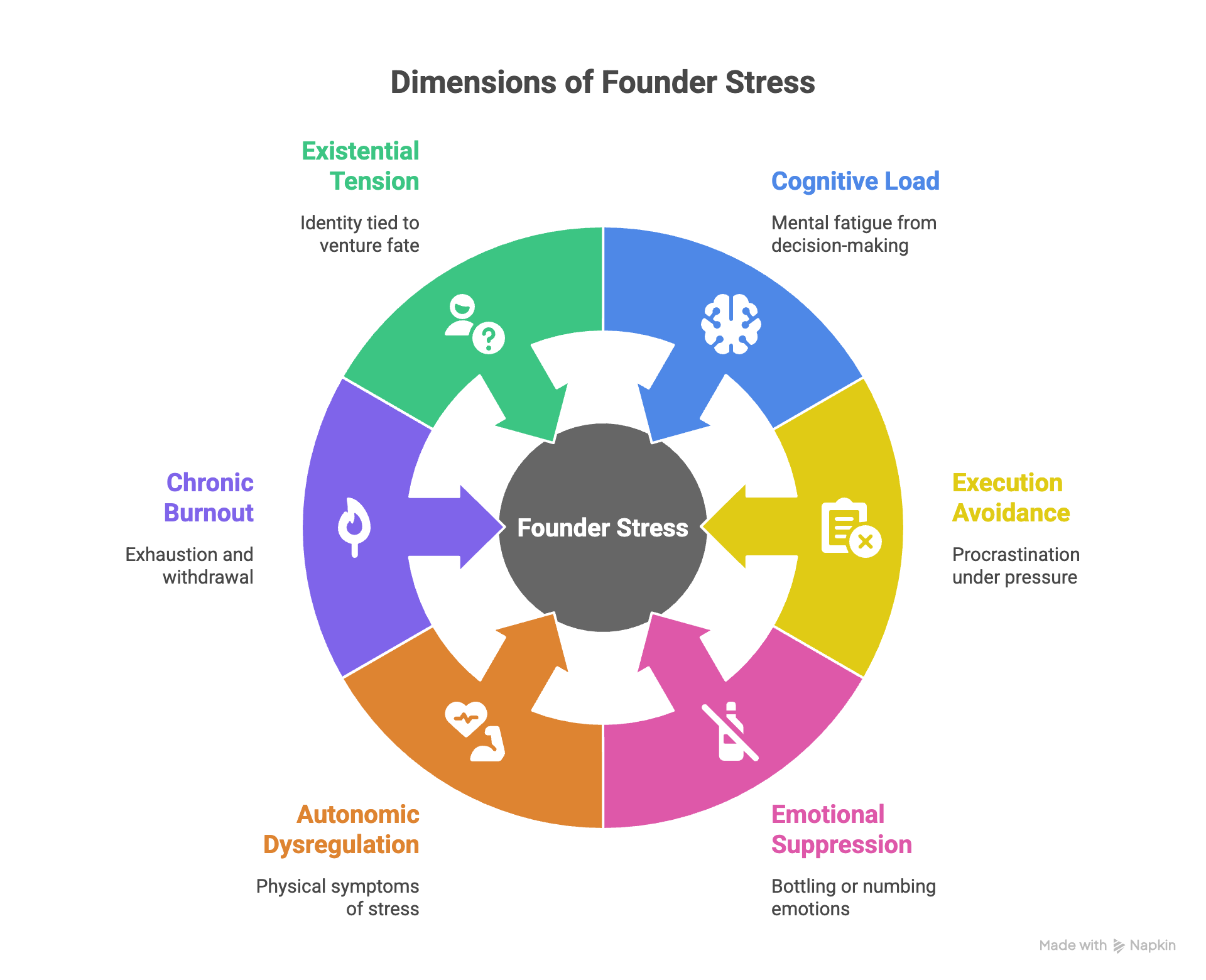
The Founder Stress Profile (FSP-40) was built to help founders catch this pattern early. It is a 40-item self-assessment that measures stress across six dimensions:
-
Cognitive Load – decision fatigue, overthinking
-
Execution Avoidance – procrastination under pressure
-
Emotional Suppression – bottling or numbing emotions
-
Autonomic Dysregulation – racing heart, tension, gut issues
-
Chronic Burnout – exhaustion, withdrawal, cynicism
-
Existential Tension – identity tied to the fate of your venture
The tool integrates insights from validated scales; including the Perceived Stress Scale (Cohen et al., 1983), Perceived Stress Questionnaire (Levenstein et al., 1993), DASS-21 Stress Subscale (Lovibond & Lovibond, 1995), the Autonomic Symptom Checklist, and the Maslach Burnout Inventory (Maslach & Leiter, 2016).
It doesn’t diagnose disease. Instead, it offers a structured mirror, showing how stress manifests across mind, body, and meaning.
Why This Matters for Business
Unchecked stress isn’t just personal – it reshapes companies.
-
Founders with low HRV overreact to market volatility.
-
Leaders in sympathetic overdrive create anxious, restless cultures.
-
Burned-out CEOs drift – either hyper-delegating or avoiding critical decisions.
Stress distorts judgment, narrows perspective, and dulls creativity. Your biology leaks into your business.
That’s why we recommend a three-lens view:
-
FSP-40 → psychological rhythm of stress
-
Lyfas HRV scans → physiological stress load
-
Blood biomarkers → biochemical confirmation
Together, they form a compass back to resilience.
Invitation
I invite you to take the FSP-40 today.
-
It’s free, private, and designed for founders and creators.
-
In just 10 minutes, you’ll know more about your stress rhythm than years of guesswork.
-
From there, you can decide: keep running on adrenaline, or build a rhythm where you – and your business – can thrive.
👉 [Take the FSP-40 Stress Profile]
References
-
Cohen, S., Kamarck, T., & Mermelstein, R. (1983). A global measure of perceived stress. Journal of Health and Social Behavior, 24(4), 385–396.
-
Levenstein, S., Prantera, C., Varvo, V., et al. (1993). Development of the Perceived Stress Questionnaire: A new tool for psychosomatic research. Journal of Psychosomatic Research, 37(1), 19–32.
-
Lovibond, S.H., & Lovibond, P.F. (1995). Manual for the Depression Anxiety Stress Scales (DASS). Psychology Foundation of Australia.
-
Maslach, C., & Leiter, M.P. (2016). Understanding the burnout experience: Recent research and its implications for psychiatry. World Psychiatry, 15(2), 103–111.
-
Shahid, A., Wilkinson, K., Marcu, S., & Shapiro, C. M. (2012). STOP, THAT and One Hundred Other Sleep Scales. Springer.
-
Boyes, A. (2020). The Anxiety Toolkit: Strategies for Fine-Tuning Your Mind and Moving Past Your Stuck Points.
-
Sri Aurobindo. (1999). The Integral Yoga: Sri Aurobindo’s Teaching & Method of Practice. Pondicherry: Sri Aurobindo Ashram Press. (includes reflections on Integral Healing, will, mind, and disease)