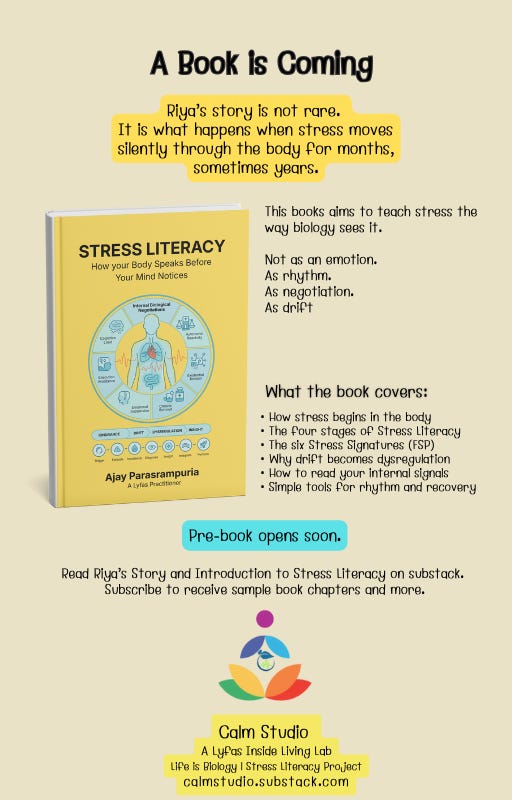

Riya’s Body Spoke First
Most people imagine stress as a feeling: overwhelm, worry, tension.
But stress usually begins much earlier, in the body;
through micro-shifts in breath,
rhythm, cognitive flow,
and autonomic balance.
Riya’s story is illustrated below, but what matters more is what the story reveals:
a complete physiological architecture beneath what we simply call “stress.”
This article walks you through that architecture, section by section, using the comic as a visual anchor.
When Physiology Interrupts Cognition
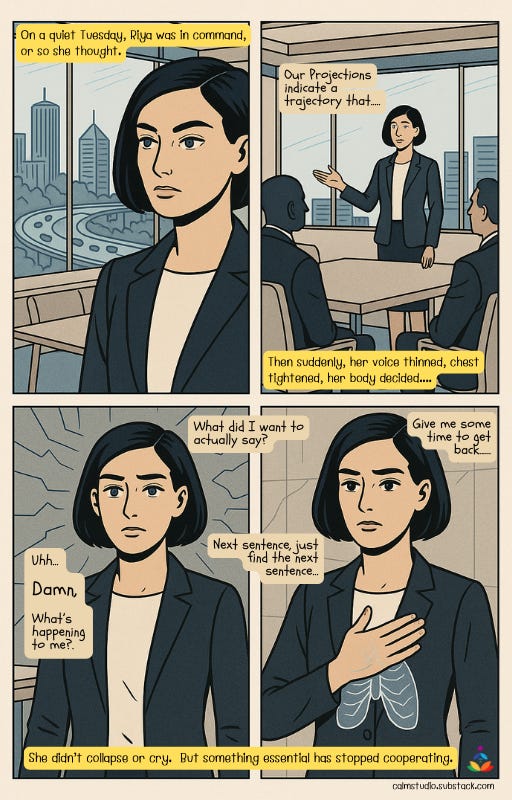
Most “stress episodes” start as interference in energy regulation, not psychology.
This is described as the moment when:
-
breath mechanics lose synchrony
-
HRV begins to drop
-
prefrontal efficiency falters
-
autonomic signals override cognitive intent
This phase is subtle. No visible breakdown. No dramatic collapse.
But inside the body, a predictable sequence of drift has already begun.
The key insight:
Your body will always signal instability long before it generates emotion.
Why Most People Misread Stress
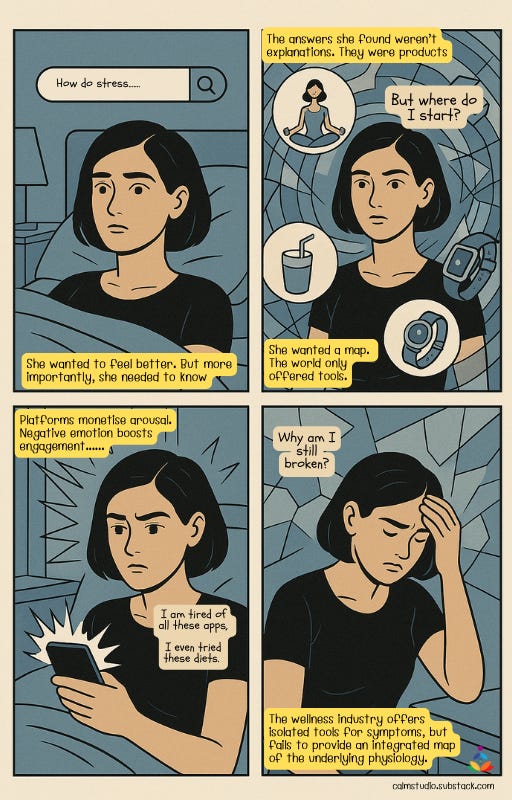
The core problem:
modern culture teaches stress management, not stress literacy.
Wellness products, motivational culture, and digital platforms offer:
-
fragmented tools
-
symptom-soothing
-
emotionally amplified content
-
advice optimised for engagement
…but almost nothing that explains what stress actually is inside the body.
“Stress interventions fail when they treat the feeling rather than the underlying physiological mechanism.”
Riya’s search reflects this gap; too many tools, no integrated map.
The Architecture Beneath Stress
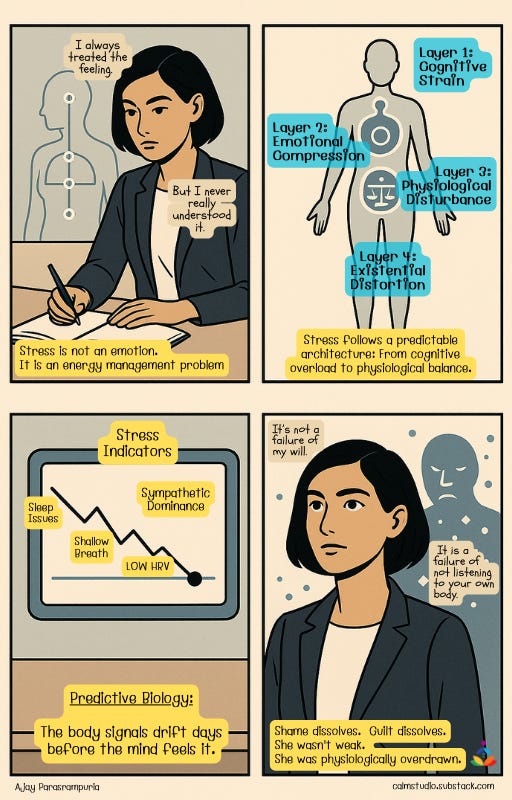
The Four Layers of Stress
-
Cognitive Strain – Working memory load, error rates, friction.
-
Emotional Compression – Blocked expression, irritability, shutdown.
-
Physiological Disturbance – HRV collapse, breath shallowing, sleep fragmentation.
-
Existential Distortion – Meaning-loss, confidence instability.
This layered progression is the central model of the paper.
Most people engage stress only at Layer 4, when it’s already overwhelming.
But early drift is detectable at Layer 1 or 2 if one knows what to look for.
This is the foundation of Stress Literacy.
The Skill of Detecting Drift
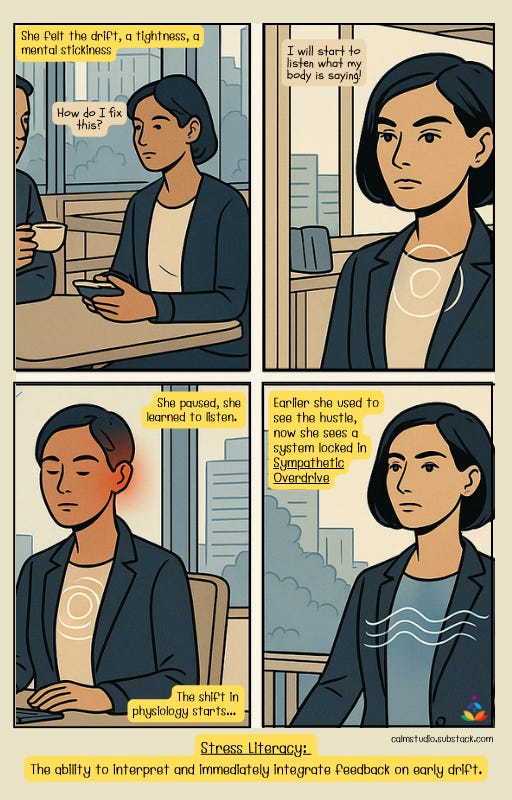
Riya beginning to sense subtle internal shifts and learn the clinical concept:
Predictive Biology
The body’s signals change days before a breakdown:
-
HRV patterns
-
diaphragmatic resistance
-
breath ratio variability
-
cognitive reaction time
-
emotional inhibition
-
autonomic symmetry
This is not intuition.
It is physiology.
The shift is measurable and trainable.
“The ability to interpret early autonomic drift and take corrective action before distress becomes pathology.”
Riya learning this is not emotional growth; it’s biological skill acquisition.
Returning With Calibration
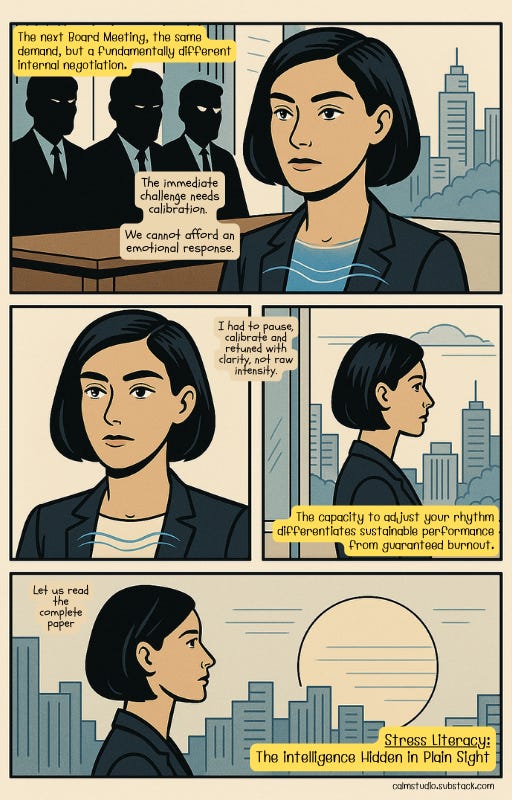
Finally, Riya faces the same work pressure from a different internal state: physiological calibration – the ability to adjust internal demand, autonomic tone, and cognitive load in real time.
This is not resilience, which glorifies endurance.
Nor is it mindset, which focuses on thought.
It is rhythm regulation.
When calibration becomes a habit, performance stabilises, decision quality improves, and the system avoids chronic sympathetic dominance, the root of long-term burnout.
“Sustainable performance emerges not from intensity but from the ability to sense and correct internal drift.”
This is the differentiator.
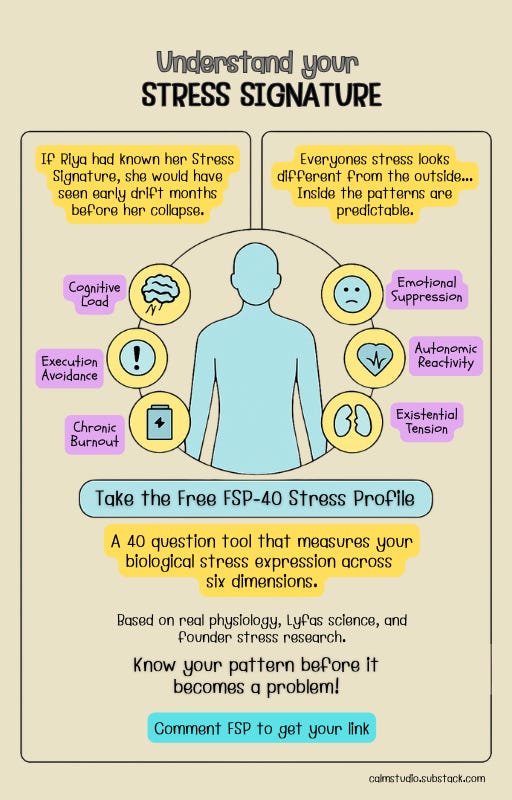
The link to FSP and the related article associate is published in the following article.